

Waterslides in the sandpit... exploring trajectory schema
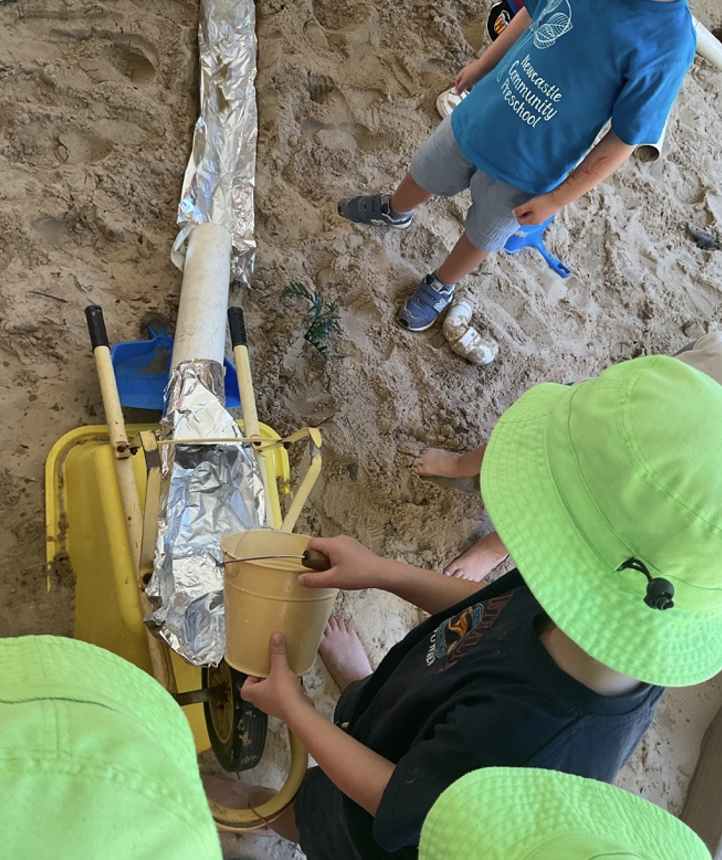
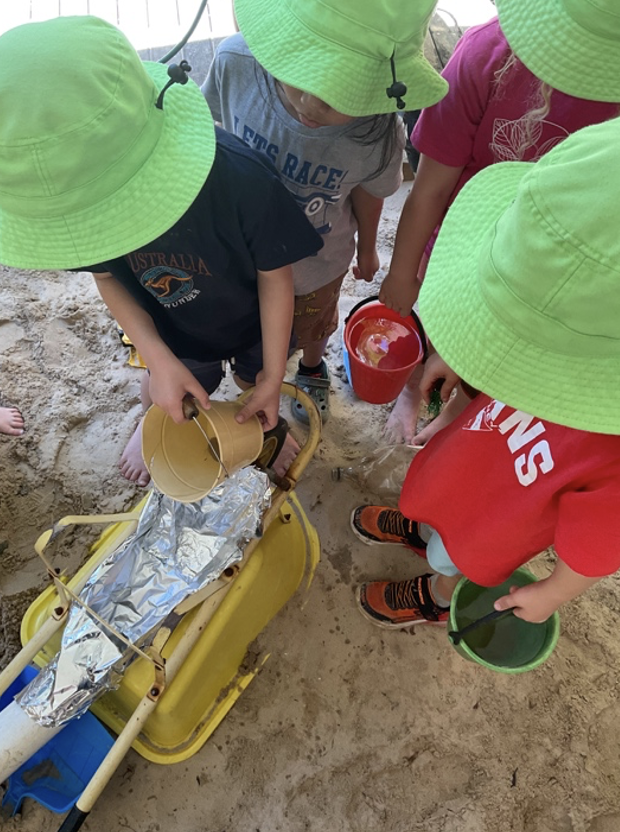
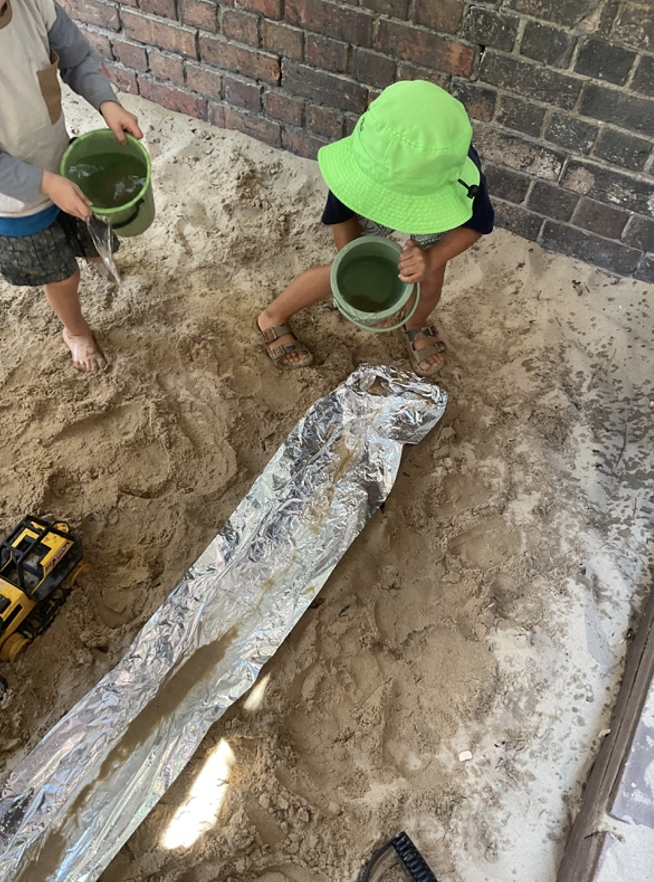
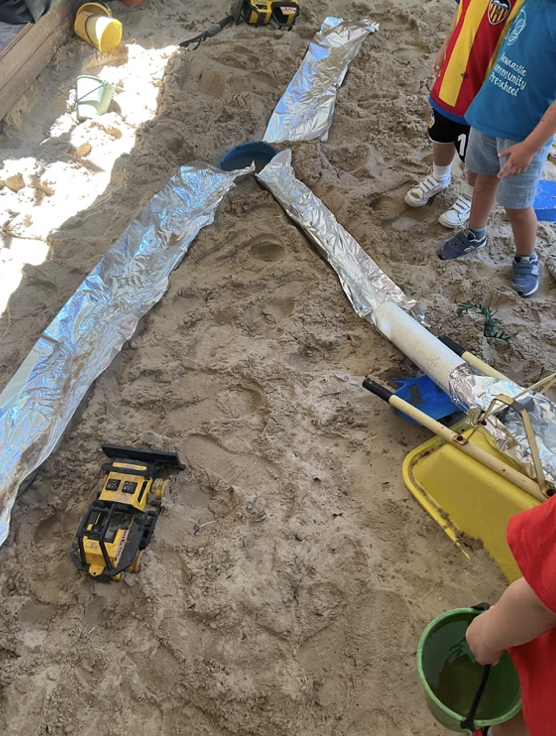
During the morning’s investigation into waterslides, Jo was invited to use foil to create a waterslide in the sandpit. He eagerly accepted, heading straight to the sandpit where Henry and Noah P quickly joined in, showing interest in the project.
Jo began by digging a trench with a shovel, supported by Alice, who helped him measure and lay out a strip of foil to act as a waterproof surface. At the end of the foil, Jo dug out a small “swimming pool” to collect the water.
To test his design, Jo poured a bucket of water from the top of the slide and watched carefully as it flowed slowly down into the pool. Observing that the water was soaking into the sand, Jo problem-solved by placing an upside-down hard hat in the pool to contain the water more effectively.
Henry then took a turn pouring the water, excitedly exclaiming, “It’s more faster!” as he watched it rush down the slide. Jo noticed how the water splashed into the pool and overflowed, describing it as “It’s exploding!” Meanwhile, Noah P used a toy truck to smooth another area of sand, preparing space for a second waterslide.
The children then began to experiment with different objects that could travel down the slide. Jo first tried a leaf, noticing how quickly it glided to the bottom. Noah tested an empty plastic bottle, commenting, “This is light,” but discovered it wouldn’t move even when he and Henry poured extra water. Together, the boys experimented with different starting points and pouring techniques, observing how the movement changed. When they tried toy cars, trees, and monster trucks, they found these objects moved more successfully, sparking laughter and excitement as they watched them race down the foil.
Jo, Henry, and Noah’s play strongly reflected the trajectory schema, a deep interest in movement, direction, and the effect of forces. Throughout their exploration, the children showed curiosity about how water and objects moved, developing an early understanding of scientific concepts such as flow, gravity, and momentum. Their experimentation with water speed, object weight, and surface design demonstrated growing spatial awareness and reasoning skills.
Through repeated testing and observation, the children explored cause and effect, noticing how different actions produced different results. They adjusted their pouring techniques, changed the angle of the foil, and tested various objects, discovering how direction and velocity influenced movement. This hands-on experimentation allowed them to test their hypotheses and make connections between their actions and outcomes.
Elke joined in the fun of playing in the sandpit, experimenting with foil to make waterslides. She decided to create a new slide leading into the pool. Using both a shovel and her hands, Elke dug a trench and carefully measured and laid the foil over it. She tested her design by pouring water from the higher end, observing as it ran down toward the pool but spilled out into the sandpit before reaching it. Noticing this, Elke compared her slide to others around the edge of the pool. She then adjusted her foil, so it extended further, hanging over the pool’s edge. After testing again, she was pleased to see the water successfully flow into the pool.
Elke’s play demonstrates strong engagement with the trajectory schema, as she explored the movement and flow of water along different paths. Her actions of digging trenches, directing water, observing its course, and adjusting the slide shows her developing understanding of direction, distance, and cause and effect. Through trial and error, Elke refined her design to achieve a continuous trajectory for the water, showing persistence, problem-solving, and spatial reasoning.
Jo, Mico, and Noah P decided to create a second waterslide. They turned a wheelbarrow upside down, using its slanted surface to form a steep slope for the water to flow down. Working together, they attached a pipe and foil to guide the water into the pool. After testing their design, Jo noticed that the pipe wasn’t working as they had hoped. He thoughtfully reassessed the setup and decided to replace the pipe with a longer one to improve the flow of water.
Lexi, Lofn, and Sumw spent time exploring how water moves by pouring it down the different waterslides and watching as it travelled towards the pool. They experimented with where they began pouring the water on the slide and how much water they used each time. Through their play, the girls observed changes in the water’s speed and flow. Lofn noticed that when she poured a larger amount of water, it seemed to move faster down the slide, sharing her discovery with her friends.
This experience shows the children’s deep engagement with the trajectory schema as they explored movement, direction, and force. By experimenting with variables such as quantity and position, Lexi, Lofn and Sumw demonstrated curiosity and early scientific thinking, making predictions, testing ideas, and drawing conclusions from their observations. Their play supported their understanding of cause and effect, as well as the physical properties of water and gravity.
Max joined the play and was inspired by what the other children had created. He decided to design his own waterslide, beginning by digging a hole to form a pool and then creating a trench to guide the water’s flow. Using pipes and shovels as supports, Max constructed an elaborate water system, carefully arranging each piece to direct the water’s path. Once his slide was set up, he tested it to see how the water travelled through his design.
Max’s engagement demonstrates a strong connection to the trajectory schema, as he explored how water moves through space and along different paths. His process of building, testing, and adjusting shows developing problem-solving skills, spatial awareness, and an understanding of cause and effect. By observing and drawing inspiration from his peers, Max extended the play through his own creative thinking, deepening his understanding of movement, flow, and design.
The trajectory schema was visible not only in the physical movement of water and objects but also in the children’s fascination with observing and controlling motion. Their sustained focus, persistence, and delight in discovery illustrated how schematic play supports early scientific inquiry, fine and gross motor coordination, and cognitive development. This experience highlighted the powerful role of play in fostering curiosity, experimentation, and a deeper understanding of how the physical world works.